
 Deutsch
 Português
 한국어
한국어 Türkçe
 عربي
عربي  русский
  Việt Nam
 日本語
日本語 Italiano
 Français
 Español


Electric Stacker
Electric Stacker manufacturer

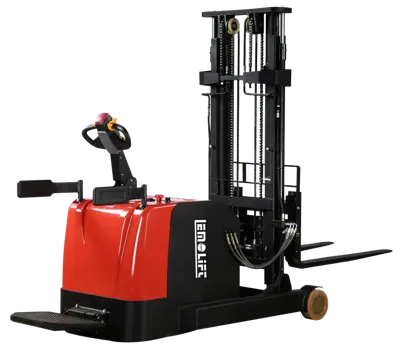
The LEMO electric stacker emerges as a paragon of professional and highly functional equipment painstakingly engineered for seamless cargo handling and stacking operations. Powered by advanced electric systems, it showcases exceptional efficiency and adaptability for diverse industrial applications. Equipped with a high - performance battery and robust electric motor, it offers reliable power to handle substantial workloads. Simple joystick manipulations allow for precise regulation of the stacker's movement and fork positioning, enabling handling of diverse goods from heavy - loaded pallets to fragile items with remarkable dexterity. This not only boosts work efficiency but also reduces operator physical strain, optimizing business operations, increasing productivity, and minimizing the risk of worker fatigue and injury, thus setting new standards in material handling for performance, safety, and user - friendliness.
Efficient operation
The advanced drive system makes the lifting and driving speed of the stacker faster, and the intelligent control system can accurately control the speed and steering of the vehicle, greatly improving the work efficiency, and can quickly and efficiently complete the task of cargo handling and stacker.
Easy to operate
Its control system design humanized, flexible control, good micromobility, control button position science, easy to operate left and right hand, even without rich experience operators can easily get started, quickly grasp the operation method, so as to flexibly cope with a variety of complex handling tasks.
safety technology
The use of dynamic anti-tipping technology, automatic fire extinguishing technology and other safety technologies, but also equipped with a variety of safety protection devices, such as lifting overload protection devices, electronic limit switches on the door frame, can effectively prevent accidents.
Simple maintenance
There is no engine and complex transmission system and other mechanical structure, the maintenance of electric stacker is mainly focused on the battery and motor inspection and maintenance, relatively simple and easy to reduce the maintenance cost of equipment and downtime.



Electric Stacker application


Automotive manufacturing workshop: The automotive manufacturing process involves the handling and assembly of a large number of parts. The electric stacker can move heavy parts such as engines and gearboxes from the storage area to the designated location of the production line, and cooperate with the automated process of the production line to ensure the continuity and efficiency of production. At the same time, between the various stations in the workshop, the electric stacker is also responsible for the transfer of semi-finished products to optimize the production layout.
Container terminals: In container terminals, electric stackers are used for stacking and short distance handling of containers. It can move containers unloaded from the ship to the designated storage yard location for storage, or transfer containers between storage yards, and cooperate with other port loading and unloading equipment to improve the loading and unloading and turnover efficiency of containers.
Large warehouse: In a large comprehensive warehouse, there are a wide variety of goods and a large quantity. The electric stacker is responsible for moving the goods from the inlet to the designated shelf area for storage, and removing the goods from the shelf to the delivery area when leaving the warehouse, improving the utilization rate of storage space and the turnover efficiency of goods.
Medical warehouse: Medical warehouse stores a large number of drugs and medical devices, the storage environment and cargo handling safety requirements are extremely high. The electric stacker has no exhaust emissions, will not cause pollution to drugs, and the operation is accurate, and can avoid damage to the cargo collision. It is responsible for the handling of drugs and medical devices in and out of the warehouse, shelves and shelves, to ensure the standard and efficient management of medical storage.
Products FAQ
1. How to choose the right electric stacker for your company?
First of all, the weight and size of the goods must be considered to determine the rated load and fork size of the stacker. For example, if you often carry heavy goods, you need to choose a model with a larger load. Secondly, the working environment is also very critical, such as the narrow warehouse channel, should choose a small turning radius model; In special environments such as cold storage, equipment that can adapt to low temperatures should be selected
2. Is the operation of electric stacker complicated? Is it easy for beginners?
The operation of the electric stacker is not complicated. Its control interface design is humanized, the operation handle and button layout is reasonable, and the function is clear. Most of the operations are controlled by simple handles, such as forward, backward, rising, descending and so on. Novice after professional operation training, usually in 1-2 days to master the basic operation skills, skilled in the handling of goods and stacking operations.
3. What is included in the daily maintenance of electric stacker?
Daily maintenance mainly includes cleaning equipment, removing dust, oil and other debris; Check the battery, check the electrolyte level (lead-acid battery), ensure that the battery is firmly connected and charged properly; Check the tire wear, clean up the debris in the tire pattern in time; Check whether the hydraulic system has leakage and whether the hydraulic oil level is normal; Lubricate moving parts, such as door frame rollers, chains, etc. Also check that safety devices such as brakes, lights and horns are working properly.
4. What factors will affect the actual load capacity of the electric stacker?
It is mainly affected by the position of the center of gravity of the goods. If the center of gravity of the goods is offset, the actual effective load will be reduced. In addition, when the battery is insufficient, the motor output power decreases, which will also affect the load capacity. Ground smoothness and slope also have an impact on the load. Uneven or sloping ground will increase the operating resistance of the equipment and reduce the actual weight. In addition, the age of the equipment and the degree of wear will also lead to a decrease in load capacity.